https://doi.org/10.1140/epjs/s11734-026-02276-0
Regular Article
Towards  -type lithium niobate: first-principles study of defect configurations and charge transport mechanisms in phosphorus-doped LiNbO3
1
Department of Mathematics and Physics, Shijiazhuang Tiedao University, 050043, Shijiazhuang, China
2
College of Science, Jiangsu University of Science and Technology, 212100, Zhenjiang, China
3
MOE Key Laboratory of Weak-Light Nonlinear Photonics, TEDA Institute of Applied Physics and School of Physics, Nankai University, 300457, Tianjin, China
4
School of Internet of Things, Xi’an Jiaotong-Liverpool University, 215123, Suzhou, China
a
This email address is being protected from spambots. You need JavaScript enabled to view it.
b
This email address is being protected from spambots. You need JavaScript enabled to view it.
Received:
22
January
2026
Accepted:
14
March
2026
Published online:
9
April
2026
Abstract
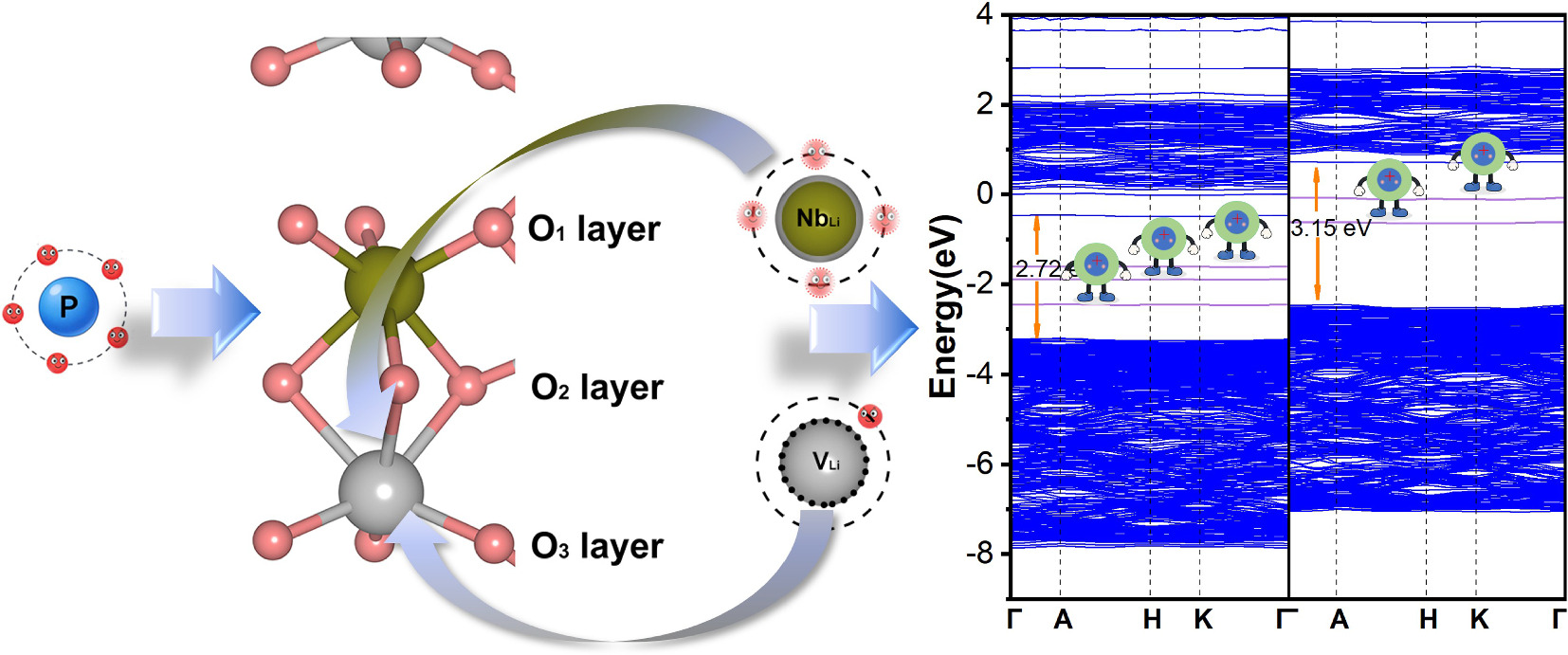
This study systematically examines the formation of phosphorus-induced point defects in lithium niobate (LiNbO3) crystals through density functional theory. The results reveal that phosphorus atoms preferentially substitute at oxygen sites, forming thermodynamically stable P0 defects. Three distinct P0 defect configurations are constructed, and their lattice distortions and formation energies are analyzed to determine the most stable atomic structure. Based on the most stable P0 configuration, the stability under different charge states is evaluated. The defect and electronic structures of P0 are systematically examined. To explore the interaction between P-induced defects and intrinsic defects in LiNbO3, two defect-pair models are established. Analysis of their electronic structures demonstrates the introduction of impurity levels within the bandgap, which substantially modify the electronic properties of LiNbO3.
Supplementary Information The online version contains supplementary material available at https://doi.org/10.1140/epjs/s11734-026-02276-0.
Copyright comment Springer Nature or its licensor (e.g. a society or other partner) holds exclusive rights to this article under a publishing agreement with the author(s) or other rightsholder(s); author self-archiving of the accepted manuscript version of this article is solely governed by the terms of such publishing agreement and applicable law.
© The Author(s), under exclusive licence to EDP Sciences, Springer-Verlag GmbH Germany, part of Springer Nature 2026
Springer Nature or its licensor (e.g. a society or other partner) holds exclusive rights to this article under a publishing agreement with the author(s) or other rightsholder(s); author self-archiving of the accepted manuscript version of this article is solely governed by the terms of such publishing agreement and applicable law.