https://doi.org/10.1140/epjs/s11734-026-02216-y
Review
Advances in starch–polyaniline conducting materials and their applications: a review
1
Department of Chemistry, UIS, Chandigarh University, Gharuan, Mohali, Punjab, India
2
Chitkara University Institute of Engineering and Technology, Chitkara University, 140401, Rajpura, Punjab, India
3
University Centre for Research and Development (UCRD), Chandigarh University, Gharuan, 140413, Mohali, Punjab, India
4
Department of Physics, University Institute of Sciences, Chandigarh University, 140413, Mohali, Punjab, India
5
Department of Physics, Faculty of Science and Arts, Najran University, P.O. Box 1988, 11001, Najran, Saudi Arabia
6
Advanced Materials and Nano-Research Centre (AMNRC), Najran University, P.O. Box 1988, 11001, Najran, Saudi Arabia
a
This email address is being protected from spambots. You need JavaScript enabled to view it.
b
This email address is being protected from spambots. You need JavaScript enabled to view it.
Received:
15
October
2025
Accepted:
14
February
2026
Published online:
12
March
2026
Abstract
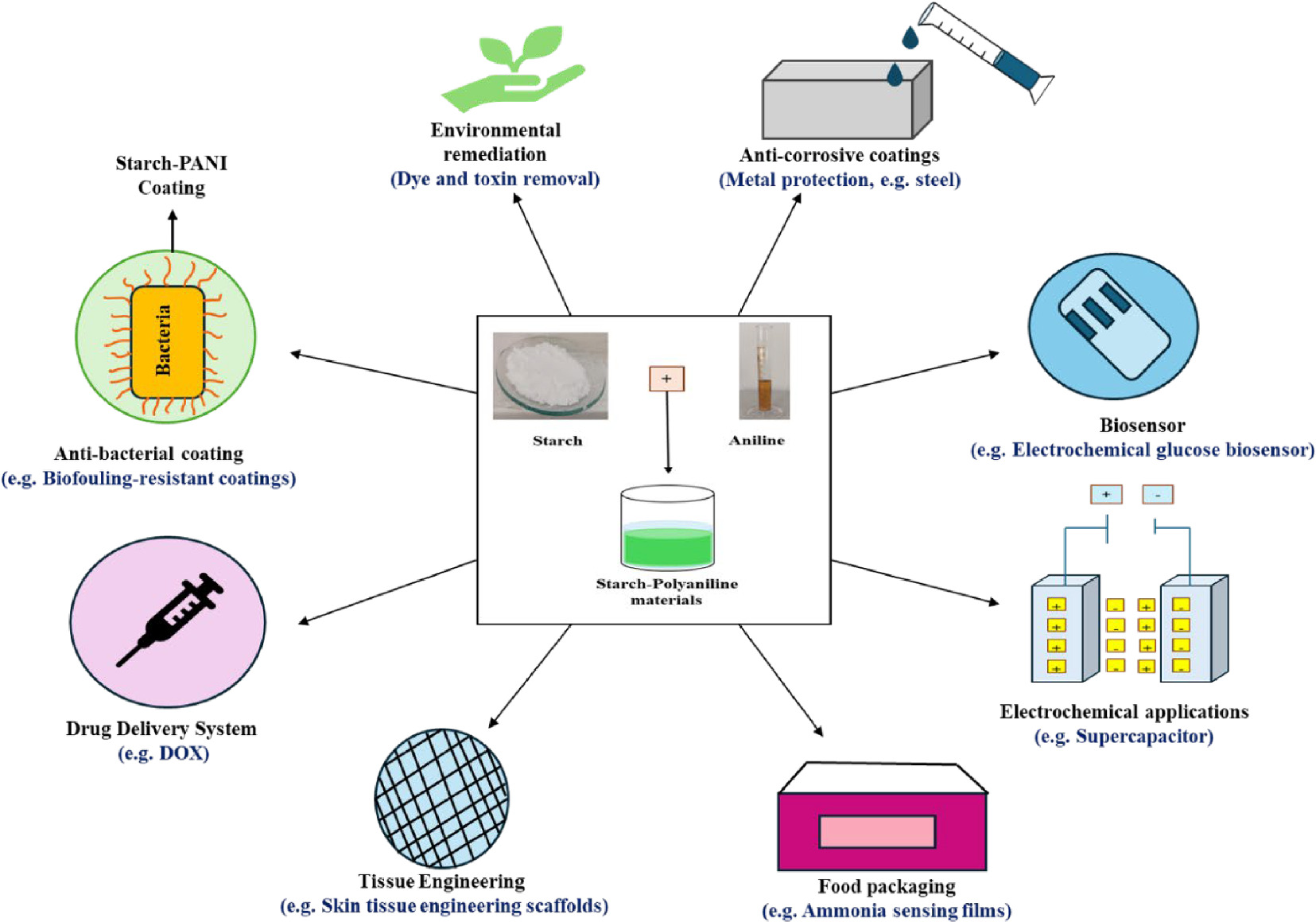
Biopolymers, sourced from natural materials, are increasingly used across diverse sectors such as food, consumer products, agriculture, cosmetics, pharmaceuticals, and electronics. Among them, starch-based polymers stand out due to their biocompatibility, biodegradability, mechanical strength, thermal stability, and hydrogel-forming ability. Nevertheless, their limited solubility and flaky morphology can restrict their practical use. Modified starch derivatives effectively overcome the inherent limitations of native starch, thereby broadening their range of applications. This review highlights the potential of starch modified with polyaniline (PANI) through techniques such as graft copolymerization, crosslinking, semi-interpenetrating and interpenetrating polymer networks (s-IPNs and IPNs), aerogel formation, blending, mixing, and composite fabrication. Starch–PANI polymer matrices have been extensively explored for decades in industrial, environmental, and electronic applications due to their combined features of electrical conductivity, environmental stability, and sustainability. The integration of starch with polyaniline enhances mechanical strength, thermal stability, electrical conductivity, and other intrinsic properties, enabling their use in the development of anti-corrosive coatings, environmental remediation systems, biomedical and chemical sensors, tissue engineering scaffolds, drug delivery platforms, and energy storage devices. Looking forward, starch–polyaniline composites hold immense potential across diverse fields, offering sustainable and smart solutions that contribute to the advancement of an eco-friendly future.
Copyright comment Springer Nature or its licensor (e.g. a society or other partner) holds exclusive rights to this article under a publishing agreement with the author(s) or other rightsholder(s); author self-archiving of the accepted manuscript version of this article is solely governed by the terms of such publishing agreement and applicable law.
© The Author(s), under exclusive licence to EDP Sciences, Springer-Verlag GmbH Germany, part of Springer Nature 2026
Springer Nature or its licensor (e.g. a society or other partner) holds exclusive rights to this article under a publishing agreement with the author(s) or other rightsholder(s); author self-archiving of the accepted manuscript version of this article is solely governed by the terms of such publishing agreement and applicable law.